September 8, 2026
The financial services industry is at an inflection point. Competitive threats have intensified, regulations have become stringent, customer expectations have shifted, and risks are evolving at unprecedented speed. According to American Banker, 78% of financial institutions reported fraud growing in both volume and complexity in 2024, with a notable surge in deepfake incidents.
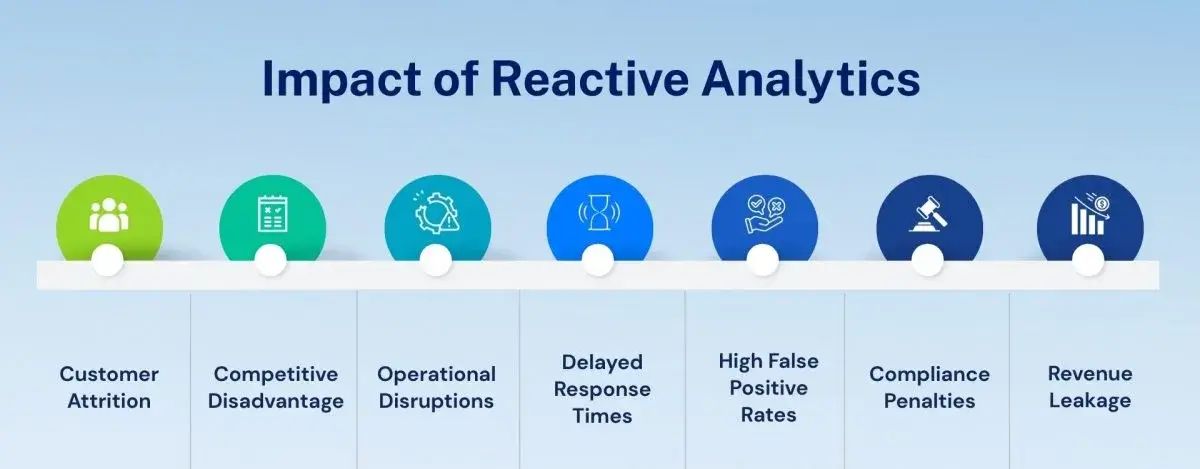
Yet many remain trapped in reactive mode, addressing issues after they occur. This retrospective approach delays decision-making, drains efficiency, hinders growth, and weakens customer trust. In today’s world of AI-enabled fraud and dynamic risk, transitioning to predictive data analytics is not optional; it is foundational for staying competitive, resilient, and future-ready.
With only 32% of banks and credit unions implementing advanced data analytics in banking between 2023-24, the struggle to extract meaningful insights persists. Common roadblocks include:
Reactive analytics examines cases in isolation, missing critical patterns. Such systems often yield false positive rates exceeding 90%, leaving financial institutions vulnerable to losses, inefficiencies, and risk.
By 2030, research indicates that analytics could redefine 44% of banking tasks, unlocking immense opportunities for efficiency and innovation.
Evaluate current capabilities, systems, data sources, and analytics maturity. Prioritize opportunities based on impact, feasibility, ROI, and strategic alignment. Define clear objectives for measurable results.
Connect siloed data to ensure accuracy, consistency, and accessibility. Launch high-impact pilot projects to validate analytics models, then scale proven models for integration with existing systems. Finally, both technical performance and business outcomes are measured to ensure effective adoption and meaningful value delivery.
Deploy high-impact models across departments. Build expertise via training, strategic hiring, and partnerships to drive sustainable transformation.
Continuously monitor, retrain models, and incorporate new data. Explore emerging trends, external insights, and cutting-edge methods to drive ongoing improvement and innovation.

Data Analytics ServiceDESK removes the barriers and accelerates the predictive transformation journey for financial institutions. It transforms complex, siloed data into clear, actionable insights with a dedicated team of data scientists, engineers, and analysts, ensuring accuracy and regulatory alignment.
Data Analytics supports the full analytics lifecycle, from information to insight to predictive foresight, aligned with the needs of modern banking:
Data Analytics acts as the bridge, accelerating every stage of the transformation journey, including assessment, implementation, scaling, and optimization, giving financial institutions the expertise, structure, and continuity needed to shift from reactive operations to predictive decision-making.