From Fragmented Data to Trusted Insights: Strengthening Financial Data Integrity

Key Takeaways

Multiple systems are used to provide financial institutions with data to support financial reporting, regulatory compliance, reconciliation, risk assessment, and customer analytics. However, if the information is spread out across different environments, inconsistencies in formats, missing information, and data that is not always traceable can impact the accuracy of these activities.
In a separate study of 124 financial institutions by Cornerstone Advisors, the average score for data quality and integrity monitoring was only 4.20 out of 10. The integration of structured and unstructured data was even lower at 3.59. This is just another reminder that gathering information is not sufficient if it is not consistently validated, linked, and kept in institutions.
The solution for financial institutions is a storage architecture that will ensure the preservation of this source information, along with clear procedures to validate, organize, and use this data. The Databricks Data Lakehouse approach comprises two key elements: Delta Lake and Medallion Architecture.

Delta Lake: Establishing Reliability at the Storage Layer

Traditional delta lake provides a centralized data store for storing large amounts of data but can be challenging to maintain consistency and reliability as data grows and evolves. These limitations can be overcome through Delta Lake with its transactional and data reliability features built on the lakehouse storage layer.
It is consistent in the case of multiple processes reading and writing data through its Atomicity, Consistency, Isolation, and Durability (ACID) transactions. Schema helps to prevent unexpected changes from compromising the databases that already exist; this happens by checking incoming records against established structures. As the source system adds new fields and modifies existing ones, the schema evolves to reflect these changes.
Another key value that data versions and time travel offer is the ability to move forward. Financial institutions can access older versions of the datasets to see how they have changed, look for any discrepancies, and meet audit needs, depending on set data retention policies.
The skills are applicable to financial activities. For instance, teams may need to investigate discrepancies between payment records and ledger entries during the reconciliation process.
The data lake improves query performance as the dataset expands while also supporting data optimization techniques. For financial reporting, compliance, and analytical workloads, these capabilities set up a more dependable storage environment.

Medallion Architecture: Organizing Data for Quality and Consistency

Reliable storage is only one part of the equation. Financial institutions must also establish a consistent process for transforming information from its original state into datasets suitable for business use.
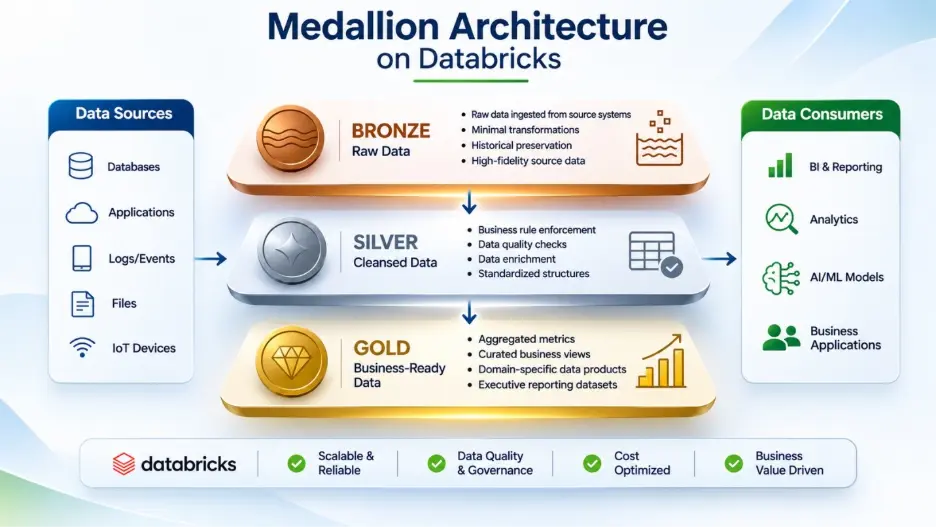
Medallion Architecture addresses this requirement through three progressive data layers: Bronze, Silver, and Gold. Each layer serves a distinct purpose, allowing institutions to apply validation and refinement as information moves through the data pipeline.
Medallion Architecture on Databricks

Building a Connected Data Foundation

By progressively refining information from Bronze to Gold, financial institutions can improve reporting accuracy, strengthen governance, and provide business users, data scientists, and AI applications with more reliable information. But a well-structured architecture is only part of the equation. Making that information meaningful also requires people who can interpret it, understand its business context, and identify what it means for the organization.
Data Analytics ServiceDESK combines data engineering with analytics expertise to help banks and credit unions put their information to better use. With technical knowledge and an understanding of financial services, the team helps improve reporting processes, identify potential risks, and give decision-makers a clearer basis for their next steps.